The Cold Corner: Finding What Makes One Spot Feel Chilly
A cool spot can come from moving air, a cold surface or the way a room is arranged. Use a careful, repeatable walk-round to gather clues before deciding what to change.
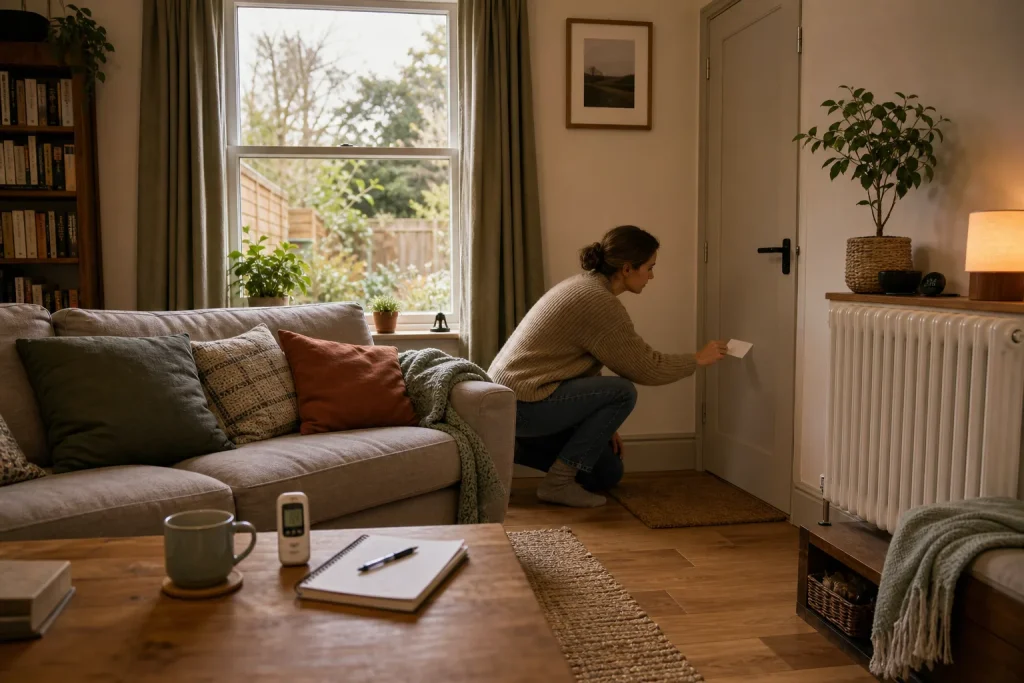
You settle down with a book and notice that one side of the sofa feels chilly, although the rest of the room seems comfortable. Before reaching for the thermostat, trace the sensation: moving air, a cool surface and the position of furniture can all feel like cold, but they point to different next steps.
Start with the room as you normally use it
Choose an ordinary time and leave doors, windows, curtains and heating settings as they usually are. Note anything unusual, such as a recently opened window, direct sunlight or a radiator that has just been turned on.
Use a simple sketch or notes on your phone to mark where the chill occurs. If you have a room thermometer, use it only as a comparison tool: keep it away from radiators, exterior glass, direct sun and draughts, and record where it sits.
Walk the same route at a calm pace. Record what you notice before changing the heating or moving furniture, so you can distinguish the original sensation from the effect of any adjustment.
Check whether moving air is involved
A draught is moving air, so look for a sensation that shifts or strengthens near an opening, joint or passage. Check the edges of a closed external door, the meeting rails and frame of a window, and places where pipes or cables pass through an outside wall.
Hold the back of your hand near a suspected gap, without touching hot pipes or electrical fittings. A loose strip of lightweight tissue can make airflow easier to see: hold it near the joint and watch for movement. Keep it away from flames, heaters and moving parts; never use a candle to search for leaks.
An extractor fan, an open internal door or ordinary air circulation can also create movement. Note whether the sensation remains with the fan off and doors in their usual positions before deciding that a seal may be at fault.
If you notice movement, record the exact section rather than labelling the whole room draughty. If the tissue stays still and the sensation does not shift, inspect surfaces and room layout instead.
Compare surfaces without treating touch as a diagnosis
Glass, an outside wall and a tiled floor can feel cooler than an interior wall, even when the air is still. A surface may draw heat from your skin as you approach or touch it, which can make that part of the room feel chilly.
Compare a safe, dry spot near the suspected area with an interior wall at a similar height. Note whether the sensation follows the surface rather than appearing as a moving stream of air. Do not press on anything damp, damaged or unusually hot.
A cool-feeling surface is a clue, not a verdict about insulation or a hidden defect. Construction, outside conditions, shading and heating patterns can all affect how it feels. A hand check cannot identify what lies behind a wall or determine whether work is needed.
Look for furniture and airflow conflicts
A sofa beside a cold window can leave you feeling the cool surface, while a tall cabinet near a radiator can obstruct warm air moving into the room. Curtains over a radiator or a rug covering a floor vent can also affect circulation.
Check the path between the radiator, the room and the place where you sit. Keep required vents clear, and do not cover or enclose a heater against its manufacturer’s advice.
Imagine the sofa arm feels cool beside a window, but tissue held at the frame stays still. You move the sofa slightly into the room, keep the curtain clear of the radiator and sit there again during normal use. If the seat feels more comfortable while the airflow and surface seem unchanged, the layout may be contributing; that observation does not rule out another cause.
Use a consistent walk-round to compare clues
Start near the centre of the room, then check the places where people sit or stand, the floor by an outside wall, window and door edges, and the area around the radiator. Use the same route and notice the same kinds of clues each time.
- Check whether the tissue moves at a window or door joint. If it moves, record the precise section for inspection; if it stays still, check nearby surfaces and furniture placement instead.
- Check whether the cool sensation shifts when you step away from a wall or window. If it does, note the distance and inspect for moving air; if it stays in one place, compare the nearby surface with an interior one.
- Check whether a suspected surface is glass, an outside wall or a floor. If it feels cooler than a similar interior surface, record its location without diagnosing insulation; if it does not, look for airflow or layout effects.
- Check whether a curtain, cabinet or sofa obstructs a radiator or vent. If it does, make a small, safe, reversible adjustment; if it does not, leave the layout unchanged and continue checking other clues.
- Check whether an extractor fan or open internal door is present when you feel moving air. If the sensation changes when the fan is off or the door is in its usual position, note that influence; if it does not, inspect the nearest external joint.
- Check whether unusual sun, an open window or a recent heating change affected the observation. If so, repeat the walk under ordinary conditions; if not, record the location and clues as a useful recurring pattern.
Write observations in plain language. “Cool air seems to move at the lower hinge side of the door” is more useful than “the room leaks”. If using a thermometer, let it settle in each location and record the position; a reading depends on its surroundings and is not a complete account of comfort.
Match the next action to the clue
Say you notice a chilly strip beside a closed back door. Tissue moves near the lower hinge, stays still along the top edge, and the wall beside the door does not feel notably different from an interior wall. You switch off the extractor fan, leave the door and heating in their usual positions, and check again; the tissue still moves at the hinge. The useful decision is to inspect that specific joint for a loose or damaged seal, rather than changing the thermostat or assuming the whole room needs more insulation.
For a layout issue, try one reversible change, such as moving a chair away from a cold window or clearing a curtain from a radiator, then compare comfort under similar conditions. Do not seal vents or alter ventilation to solve a local chill; they may be needed for safe, healthy air exchange.
If condensation, mould, persistent damp, a damaged window or a suspected building defect is present, do not rely on touch alone. Ask a qualified building professional or landlord to assess the feature, particularly if you rent or the issue may involve the building fabric. Keep your notes specific: location, nearby features, whether air seemed to move and what changed after an adjustment.