A Bathroom’s Route for Moist Air
An extract fan can only clear damp air if it has a clear path out and replacement air can enter the bathroom. Trace the route, spot common blockages and work through practical checks in order.
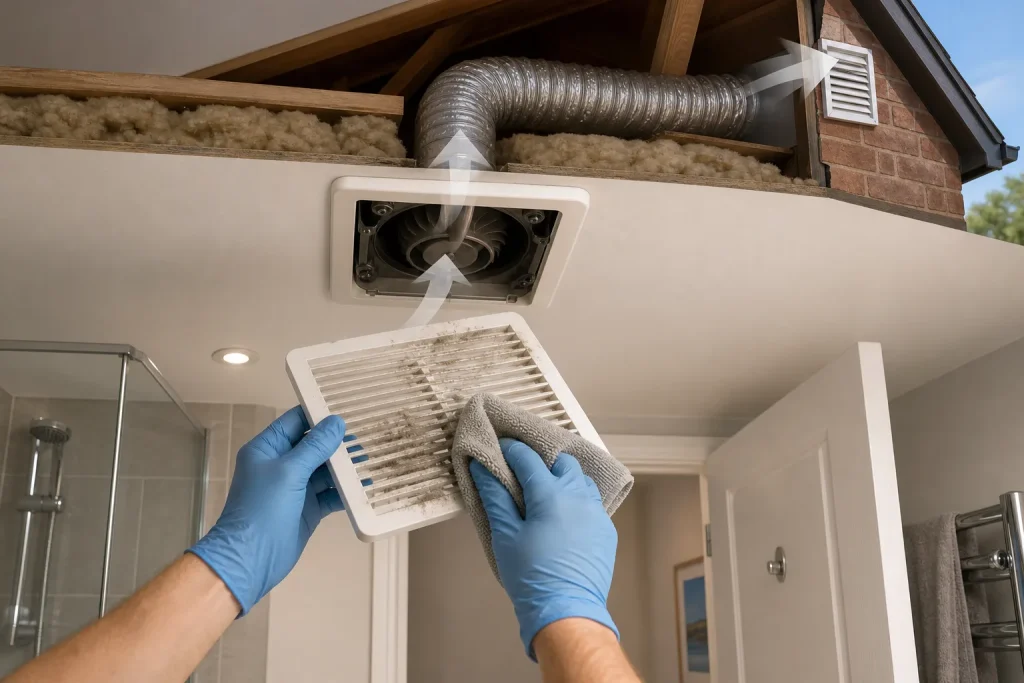
After a shower, the mirror stays clouded and the bathroom door is shut. You switch on the extract fan, but the dampness lingers. The fan may be running while moisture remains because air cannot reach it, the duct route is obstructed, or the moist air is discharged somewhere unsuitable.
Think of ventilation as a route: air enters the bathroom, moves towards the extract grille, travels through ducting and leaves the building. A fault anywhere along that route can affect how the room clears. Check only the visible, accessible parts; ask a suitably qualified ventilation professional to assess uncertain duct routes, discharge locations or changes that could affect building safety or compliance.
Trace the route from the room to the outside
Find the extract grille, usually on the ceiling or high on a wall, and identify the normal controls. The fan may start with the bathroom light, a separate switch, a humidity sensor or a pull cord. A fan with a run-on control may continue after you leave the room.
Work out where the duct is intended to discharge. Moist air should be conveyed to a suitable outdoor terminal, not simply released into a loft, roof void or cavity. If you cannot identify the outlet from a safe, accessible place, do not remove fixed covers, enter a void or climb onto a roof. Ask a qualified ventilation professional to trace the route.
The correct outlet, duct arrangement and any fire-safety precautions can depend on the building and its ventilation design. Have a competent professional verify them before altering ducting or openings.
Check visible obstructions before suspecting the fan
A running sound confirms that the fan is operating in some way, not that air is moving effectively. Dust on the grille, a stuck shutter, a kinked flexible duct or a loose connection may restrict the route. A long or poorly arranged duct can also affect how the fan works.
Turn the fan off before cleaning a removable grille, and follow the manufacturer’s instructions. Use a soft brush or cloth on accessible surfaces; do not push debris into the duct or put water near electrical parts. If you are unsure how to remove a cover, leave it in place and arrange a service visit.
With the fan running, hold a small piece of tissue near the grille without letting it touch or cover the opening. If it is not drawn towards the grille, treat that as a reason for further investigation, not as a performance measurement. If the fan is unusually weak, rattly or silent, stop troubleshooting and contact an electrician or ventilation professional.
Say you find a dusty grille, and the fan starts with the light but barely moves a tissue. You switch the fan off, clean only the accessible grille and try again; if the tissue still is not drawn towards it, you ask a professional to inspect the fan and duct rather than dismantling the ceiling.
Check the intended air path into the bathroom
An extract fan needs replacement air, but the suitable route depends on the home’s ventilation design. If the door is tightly fitted and no designed air path is available, the fan may struggle to draw air through the room. A transfer path might be provided by a door undercut or a grille, but do not assume that either is appropriate for every home.
Look for an existing path and keep it clear of mats, towels and stored items. If the fan seems to work differently with the door open, note that observation; it can help a professional assess the air path. Do not cut a door, fit a grille or leave a window open as a permanent substitute without checking what the system requires.
Before changing a door or adding an opening, ask a competent ventilation professional to assess the arrangement. Alterations may affect fire safety, privacy, noise control or the home’s intended ventilation system. Follow the system instructions and seek professional advice before blocking or adding openings.
Respond to signs of moisture beyond the room
If dampness appears in a loft, ceiling void or adjacent cavity, the duct may be damaged, disconnected or discharging in the wrong place. From a safe, accessible position, note visible signs such as a loose exterior grille, accessible duct damage or staining near the route. Do not enter a confined void or climb onto a roof to investigate.
If you cannot confirm that the duct ends outdoors, or you see dampness along its route, arrange an inspection. A qualified professional can trace the discharge point and assess the duct and joints. Avoid sealing an opening or disconnecting a duct as a quick fix; either action could leave moist air with a less suitable route.
Persistent condensation or mould can have more than one cause. If the problem keeps returning or is widespread, seek advice from a qualified damp and ventilation specialist. Follow sensible precautions when dealing with small areas, and get professional help if you are unsure how to handle the material safely.
Check the controls if the fan stops too soon
A fan that switches off with the bathroom light may not run long enough to clear lingering moisture. Some models have an adjustable run-on timer or humidity control; others operate differently. Check the instructions or ask the installer before changing a setting.
If a run-on timer is present, check whether its control has been set as intended. Do not open the fan housing to reach wiring or internal parts. Ask a qualified electrician to handle electrical connections or control changes.
Use the fan during bathing and afterwards in line with its instructions, while keeping any intended air path clear. If moisture repeatedly lingers despite normal operation, have the equipment and route checked rather than assuming a sensor or timer is working as intended.
Match each symptom to a safe next action
- The fan does not start: Check the normal switch, pull cord or control against the instructions. If the control appears to be used correctly and the fan remains silent, ask a qualified electrician to investigate; do not open the housing.
- The fan runs but the tissue is not drawn towards the grille: Check whether the accessible grille is dusty, with the fan switched off before cleaning. If the tissue still is not drawn towards the grille afterwards, arrange a fan and duct inspection; do not treat the tissue check as a measurement.
- The fan seems to work differently with the door open: Check whether an existing designed transfer path is obstructed by a mat or stored item. If it is clear or no path is apparent, ask a ventilation professional to assess the intended air supply; do not cut the door or add a grille yourself.
- Dampness or staining appears near an accessible duct route: Note where it is visible without entering a void or climbing. If the duct route or outlet is uncertain, arrange a professional inspection; do not seal or disconnect the duct.
- Condensation returns after the fan has run: Check the normal control and the manufacturer’s instructions for any run-on feature. If the fan appears to operate as intended but moisture keeps returning, ask a qualified specialist to assess the ventilation and other possible causes.
- You cannot identify where the duct ends: Check only from a safe, accessible location. If there is no clear outdoor outlet, request a professional inspection rather than entering a roof space or climbing to the roof.
Keep the accessible parts clear
Once the route has been checked or repaired, wipe dust from the accessible grille when needed, keep the designed air path unobstructed and use the fan as its instructions specify. If you notice a new rattle, a loose outlet or dampness beyond the bathroom, arrange an assessment before attempting duct or electrical repairs.
When asking for help, describe what you observed: whether the fan starts, whether the grille was clean, whether the door position changes what you notice and where dampness appears. Those details help a qualified professional decide what to inspect, while leaving uncertain duct, electrical and fire-safety questions to someone equipped to assess them.
Along the same line
After the Patch: Change the Move, Keep the Method
An update arrives before your usual evening matches, and one line catches your attention: the scout’s…

A Preliminary Check for a Loose Refrigerator Door Seal
Inspect a refrigerator door seal for dirt, damage and uneven contact, then decide whether to clean…