One Thermostat, Several Rooms: What the Controls Can and Cannot Tell You
A central thermostat controls heating according to conditions at its location, while radiator valves and schedules shape how heat is distributed. Learn how to interpret the controls without assuming one setting suits every room.
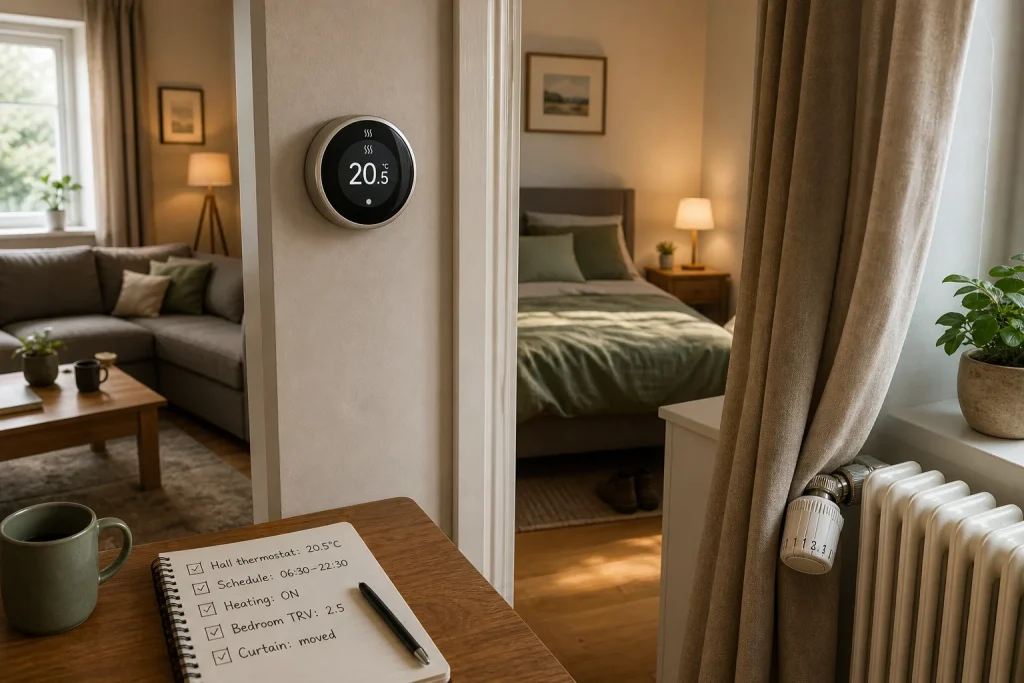
You turn up the hall thermostat, hear the heating start, and expect the bedroom to catch up. But a central control responds to the conditions around itself; it does not directly measure or regulate every room. Knowing which control does what makes it easier to interpret the display and choose a sensible next action.
The central thermostat controls the heating call
A central thermostat senses the air near its unit and uses its control logic to request heat or stop requesting it. Its display is not an average of the house, and a set temperature is not a promise that every room will reach the same conditions.
For instance, a hall warmed by cooking or sunlight may reach the thermostat’s target before a bedroom does. The heating call may then change even though the bedroom still feels cool. The precise behaviour depends on the heating system and its controls.
Use the display to understand what the thermostat senses, not as a report on every room.
Radiator valves control heat locally
A thermostatic radiator valve (TRV), where fitted, responds to conditions near its radiator and adjusts the flow of hot water locally. Its numbered or marked setting is a control position, not a precise room-temperature reading. A central thermostat and a TRV may therefore influence different parts of the same heating system.
Their interaction depends on the system design and how the controls are installed. If the thermostat and a TRV appear to be working against each other, check the manufacturer’s instructions or ask a qualified heating professional to explain the intended arrangement before changing settings. Do not assume that turning one control up will resolve the behaviour.
Keep curtains and furniture from trapping air around a TRV, so it can respond to the air near it.
Schedules decide when heat is available
A heating schedule sets periods when the system is intended to provide heat, subject to the thermostat and other controls. It does not confirm that every room has reached a particular condition. A closed door, room use and the way heat moves through the home can all affect how a space feels.
If you adjust a schedule, change one setting at a time and note what the control shows and whether the rooms you use feel more comfortable during the usual routine. If the result is unclear, return to the previous setting rather than making several changes at once.
Make schedule changes in small, reversible increments and keep a note of the original setting.
Check the control behaviour before changing settings
- Thermostat display: Check whether it shows the set temperature, sensed temperature, schedule or heating-call status. If the display is unclear, consult the model’s instructions; otherwise, use the displayed status as one clue rather than a room-by-room reading.
- Schedule: Check whether the current time falls within a heating period. If it does not, wait for the next scheduled period or use the approved temporary override; if it does, check the other controls rather than repeatedly raising the target.
- TRV position: Check whether the radiator valve is unobstructed and note its current setting. If it is covered by a curtain or furniture, clear the obstruction and observe whether its response changes; if not, consult the instructions before altering the setting.
- Heating status: Check whether the thermostat indicates that it is requesting heat. If it is not, consult the control instructions to identify whether the target or schedule explains this; if it is, but the system does not respond as expected, contact a qualified heating professional.
- Radiator condition: Check whether the radiator warms during a period when the system is calling for heat. If it warms, leave the controls unchanged while observing the room’s response; if it remains cold or heats unevenly, follow the appliance guidance and seek professional advice.
- Room-use pattern: Check whether a closed door or a change in how the room is used coincides with the discomfort. If so, try the usual door position and observe whether comfort changes; if not, avoid treating the thermostat display as a diagnosis and seek advice if the problem persists.
Work through one control change at a time
Say you find the hall thermostat set to a target, its display shows a lower sensed temperature, and the schedule is currently active. The sitting room feels comfortable, but the bedroom feels cool; its radiator valve is partly covered by a curtain. First, note the thermostat and valve settings, then move the curtain clear without changing either control. During the next ordinary heating period, observe whether the bedroom radiator responds and whether the room feels more comfortable. If it does, leave the settings as they were; if it does not, restore the usual curtain position if needed and check the system instructions or ask a qualified professional before adjusting interacting controls.
This approach does not diagnose a fault, but it separates an obvious obstruction from a control-setting change. Keeping a brief note of what you changed and what the display and radiators did makes a follow-up conversation with a heating engineer more useful.
Know when the controls cannot answer the question
A thermostat can indicate what it senses and, depending on the model, whether it is following a schedule or requesting heat. It generally cannot explain why a radiator stays cold, identify a fault in a boiler or pump, or confirm that a room is being heated as intended.
Follow the appliance and control instructions. If the system behaves erratically, a radiator does not warm as expected, or you suspect a fault, contact a qualified heating professional. Do not remove covers or work on gas or electrical components yourself.
When the control display and the rooms seem out of step, treat that as a reason to check the system’s instructions—not a reason to keep turning up the thermostat.
Along the same line
After the Patch: Change the Move, Keep the Method
An update arrives before your usual evening matches, and one line catches your attention: the scout’s…

A Preliminary Check for a Loose Refrigerator Door Seal
Inspect a refrigerator door seal for dirt, damage and uneven contact, then decide whether to clean…