A Preliminary Check for a Loose Refrigerator Door Seal
Inspect a refrigerator door seal for dirt, damage and uneven contact, then decide whether to clean it, consult the manual or arrange a repair.
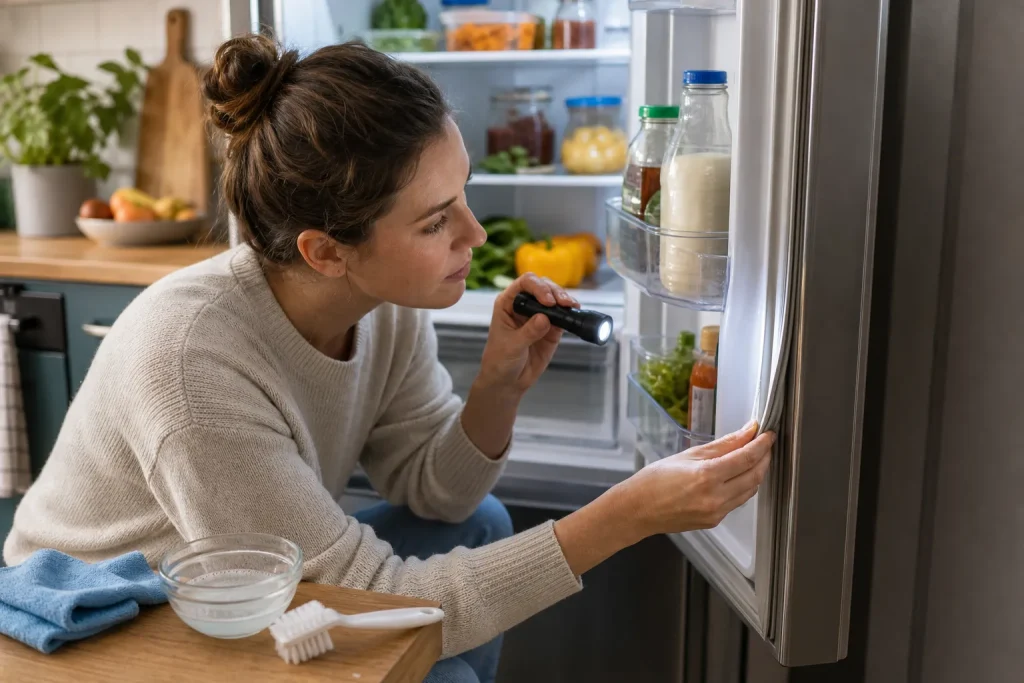
You close the fridge after putting away the milk, but one corner of the door springs back slightly. Before pressing it shut again or ordering a replacement seal, check what is actually stopping the door from closing properly. A preliminary inspection can help distinguish a dirty or obstructed seal from damage that needs advice from the manufacturer or an appliance engineer.
The rubber strip around the door is commonly called a gasket or seal. It cushions the door and helps it meet the cabinet. These checks can highlight visible problems, but they are not a diagnostic test and cannot identify every fault in the appliance.
Inspect the seal and the surfaces it touches
Look around the full perimeter, including the top corners, bottom edge and side nearest the hinges. Use a torch if the kitchen is dim. Check for food residue, sticky patches, crumbs, cracks, splits, flattened sections or rubber that has pulled away from its channel.
Run a clean finger lightly along the seal. Look for a loose section, a fold or a twist, but do not tug hard or try to prise the seal out. Check the cabinet surface where the seal meets it, too: dried sauce or a crumb can interrupt contact even if the rubber looks sound.
Check whether an item projects beyond a shelf, a drawer is not fully in place, or a bottle in the door prevents it swinging shut. Clean visible grime with a soft cloth dampened with warm water and a little washing-up liquid, then wipe away residue and dry the area. Avoid abrasive pads, sharp tools and strong cleaners unless the appliance manual specifically approves them.
Clean an intact seal before judging its contact
If you find removable dirt but no obvious tear, hardening or loose section, clean the seal and the matching cabinet surface. Close the door gently and check whether it stays shut, meets the cabinet evenly and has no visibly folded edge.
Say you notice a sticky patch near the lower hinge and a crumb caught in the fold. You clean and dry both the seal and the cabinet surface, then close the door. If it sits flush and stays shut, the dirt may have been obstructing contact; if a gap remains or the door shifts open, inspect for other causes rather than assuming the seal is fixed.
If residue returns quickly, check for a leaking container or a shelf arrangement that makes spills more likely.
Use the manual before trying to reseat a loose section
If the rubber looks twisted, pulled away or uneven but is not visibly split, first remove anything blocking the door and make sure shelves and drawers are seated. Then consult the appliance manual for instructions on inspecting or reseating that type of seal.
Seals attach in different ways. Do not assume that heating the rubber, pulling it free or pushing it into place is suitable for your model. Follow the manufacturer’s instructions, and stop if the seal resists or the fitting method is unclear.
Check whether the fridge stands as the manual specifies and whether the door closes without lifting, pushing sideways or holding it. If the door looks crooked or the hinges seem loose, seek model-specific advice instead of adjusting parts by guesswork.
Ask about a replacement for visible damage
A clear split, missing piece, stiff section or persistent gap after cleaning and removing obstructions deserves attention. Take a clear photograph and note the appliance’s model details before contacting the manufacturer or a qualified appliance repairer.
Check the manual or manufacturer’s support information for the correct part and approved fitting method. A seal that looks similar may not suit your fridge. If the instructions describe replacement as a service task, or you are unsure how the door or seal comes apart, arrange professional help rather than forcing it.
Do not use adhesive, tape or household lubricant as a substitute for a proper repair unless the manufacturer explicitly recommends it. These materials can interfere with contact, leave residue or make later service more difficult.
Compare contact only as a preliminary check
If the seal looks sound but the door does not seem to meet the cabinet evenly, clear anything blocking it, make sure drawers and shelves are seated, and close it slowly while watching the edges. Check that a nearby wall, handle, cabinet or item left on top does not interfere with the door’s movement. Follow the manual’s instructions about the appliance’s position; do not force it into a tight space or alter its feet by guesswork.
A plain sheet of paper can provide a preliminary comparison, but it is not a diagnostic test. Place it between the seal and cabinet at one point, close the door, and gently draw it out. Repeat at several points around the edge. If it slips out more easily in one area, inspect that spot for dirt, a fold, a gap or a possible alignment issue. The paper cannot identify which component is responsible or prove that the seal needs replacing.
If the door closes unevenly, the hinges appear damaged or a gap persists after you clear obstructions, consult the manual’s troubleshooting section or contact a service professional. A visual check cannot rule out a problem with the door, hinges or installation.
Use recognised food-safety advice for cooling concerns
If the seal looks clean and intact and the door meets the cabinet, but the fridge seems unusually warm or runs more than expected, those signs alone do not identify a worn seal. Check the manual for the recommended temperature setting, loading guidance and troubleshooting advice for your model. Keep the door closed while checking, and avoid repeatedly changing controls based on a brief impression.
If you are concerned that food may have been kept at an unsafe temperature, consult the UK Food Standards Agency’s food-safety guidance for advice on storage and whether to discard it. If you cannot assess the food safely, do not eat it; contact the local authority food-safety team or a qualified food-safety professional if you need help interpreting the guidance. For a persistent cooling problem, contact the manufacturer or a qualified appliance engineer. Do not open electrical panels or attempt refrigerant repairs.
Match the next action to what you observe
- Observation: The seal has removable grime but no visible damage. If cleaning removes it and the door meets the cabinet evenly, then keep the area clean; otherwise inspect for a fold, gap or obstruction.
- Observation: A crumb or container blocks the door. If removing it lets the door close evenly, then rearrange the shelf or container; otherwise continue checking the seal and door.
- Observation: The seal appears folded or loose but not torn. If the manual explains how to reseat it, then follow those instructions; otherwise contact the manufacturer or a repairer.
- Observation: A section is split, missing or stiff. If the manufacturer lists an approved replacement and fitting method, then use that information; otherwise ask a qualified repairer to identify the correct part.
- Observation: Paper slips out more easily at one point than at others. If you can see dirt or a fold there, then clean it or consult the manual as appropriate; otherwise treat the comparison as inconclusive and seek model-specific advice if the gap persists.
- Observation: The door looks crooked, the hinges seem damaged or cooling remains a concern. If the manual gives a relevant troubleshooting instruction, then follow it; otherwise contact the manufacturer or a qualified appliance engineer.
Keep the model number, a photograph of the affected area and a brief description of what happens when the door closes ready for a support call. That information helps the adviser distinguish a visible seal issue from a problem that needs a closer inspection.
Along the same line
After the Patch: Change the Move, Keep the Method
An update arrives before your usual evening matches, and one line catches your attention: the scout’s…

One Thermostat, Several Rooms: What the Controls Can and Cannot Tell You
A central thermostat controls heating according to conditions at its location, while radiator valves and schedules…